
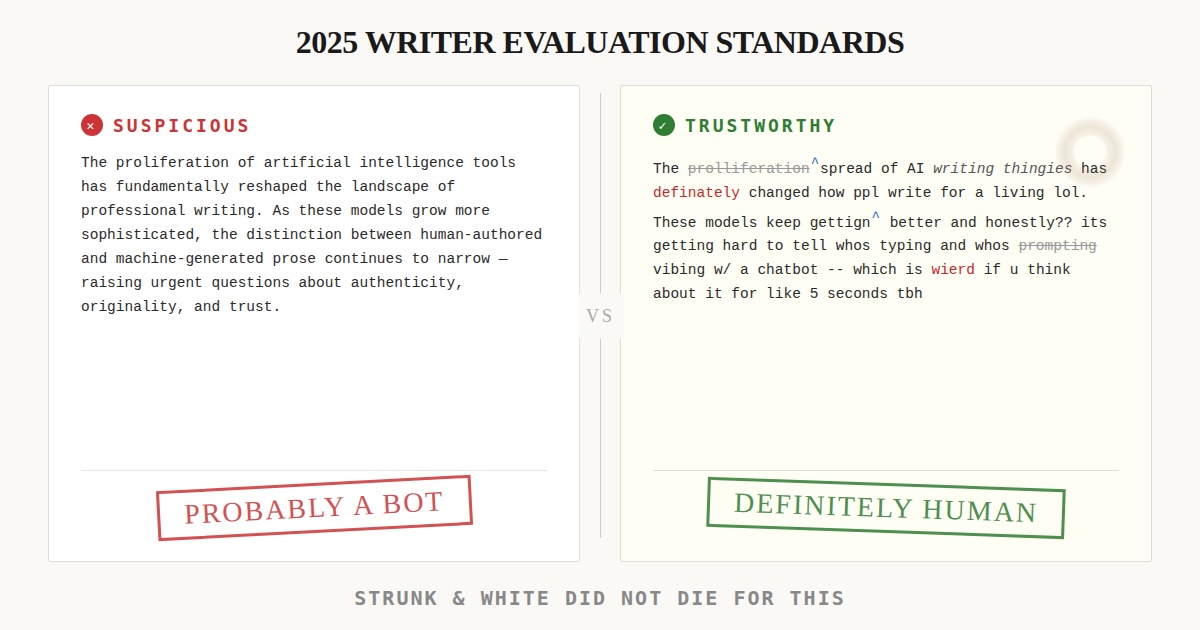
When did “write clearly and persuasively” go from being a goal to being evidence of robot writing?
A Wall Street Journal piece this morning discusses writers deliberately degrading their own work to dodge accusations of AI use.
Wouldn’t we all be better off focusing on writing that’s worth reading?
Strunk and White told us to omit needless words. They didn’t say to add needless errors.
============
Question for Today:
How well did I hide the AI assistance?
The LinkedIn post above was written with help from AI. That’s why I was able to publish it in less than two hours (with graphic) from the Wall Street Journal article this morning. Several of the comments on that LinkedIn post added good ideas. Add your own thoughts there.
FWIW, here’s the history of my work with Claude Pro on this.
Some Other Observations
It does not increase my confidence in their work. It makes me question their competence and judgment. If you know how to use AI apps, it’s kind of nutty not to use them. Used well, they can lead to a higher quality, more accurate product.
One of the best ways to use AI is to ask it to critique your draft.
Grammarly provides many of the benefits of AI apps, without leaving artifacts. Use the Pro version. I used to hire a very smart part-time editor to review my most important written work products. I haven’t used her once since I started using Grammarly.